
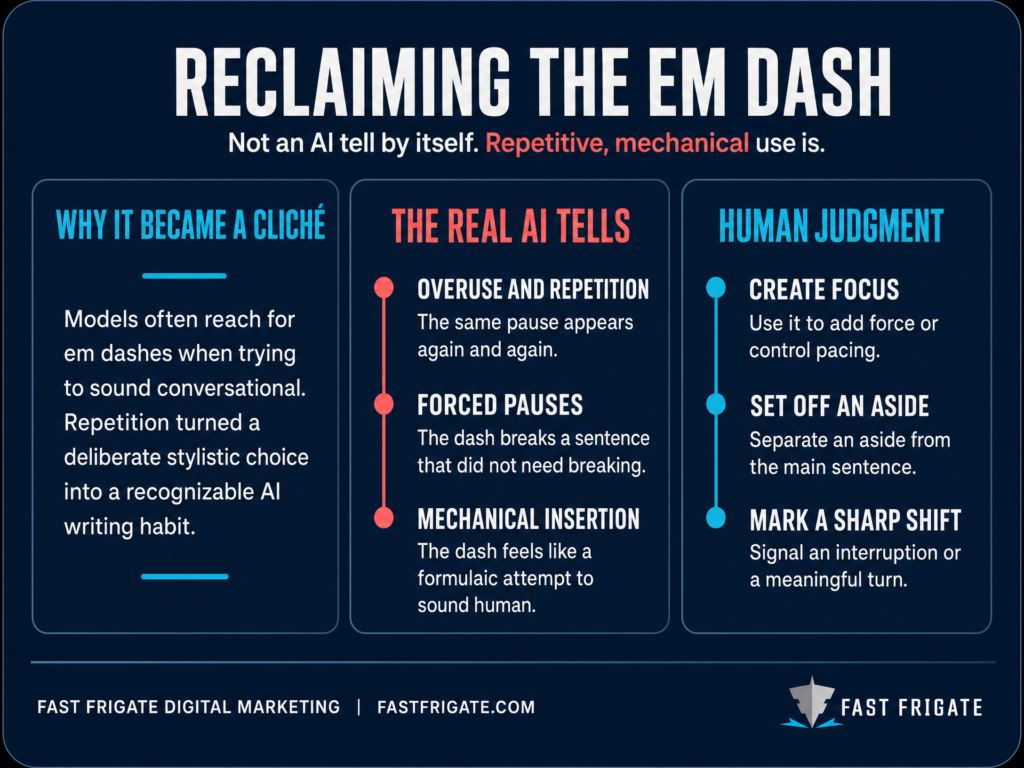
The em dash has become a familiar visual cue in AI-generated content, yet it cannot prove whether a human used a language model like a content vending machine or as an assistant guided by human judgment. Fast Frigate has long been annoyed by LLMs’ proclivity for using em dashes, in spite of how many hundreds of times we’ve told them not to. This post explains why the association formed, what remains unknown about model behavior, and how an editorial process can keep this stubborn punctuation habit out of client copy with (at least) increased success.
There is an odd little tension in web publishing right now. A writer uses one em dash, a reader squints skeptically, and the whole piece gets treated like it came out of a chat window five minutes ago. That reaction did not appear from out of nowhere. A lot of model written copy reaches for the same pause, the same pivot, and the same tidy “not this, that” construction. The pattern became easy to see. Then people started seeing it everywhere.
That does not mean an em dash exposes the author as some kind of fraud. It means the mark has become part of a larger social shorthand for generic AI prose. That distinction matters for writers who have used the dash for years and for marketing teams trying to keep AI assisted work from sounding copied from the same invisible template.
AI For Content – Should We Feel Guilty?
That’s a key word worth pausing on for a moment: assisted. AI for authoring should be an efficiency gain for humans. Not an all-in-one content creation solution. Not a one stop shop for the unimaginative masses. Those who treat it otherwise aren’t going to see significant performance gains. Their lazy work is just going to add to the rest of the AI-generated slop assailing search engines and AI summaries/citations before being enthusiastically ignored by the bots.

And you do not need to make your copy sloppier to prove a person touched it. You need a real editorial standard. Or an exceptional set of content humanization directives, like the 18-phase set we’ve been curating and noodling with since late 2022.
As proud of we are of those directives, guess what they haven’t yet been able to overcome? You guessed it…
Table of Contents
The Em Dash Became a Suspicion Trigger
The em dash did not become a “ChatGPT hyphen” through a grammar ruling. It became a tell through repetition. Readers began noticing it in product descriptions, LinkedIn posts, student work, help-center copy, press releases, and the sort of bland thought leadership that lands in an inbox with a smiley face and no point. The mark often appears in a familiar place: just before a contrast, an aside, or a final bit of emphasis. A few examples in one article may pass unnoticed. A dozen across a few short paragraphs looks less like a writer’s preference and more like a default setting.
Public conversations about the habit now have their own feedback loop. People notice the dash in model output, joke about it, and become more alert to it in human work. Human writers see that reaction and cut the dash from their own sentences. That makes the remaining examples feel more conspicuous. It is not a clean test of authorship. It is a cultural cue that gained steam through constant exposure.
There is a practical reason marketers should care. Brand voice gets judged in seconds. When a prospect sees copy that feels generic, the issue is not one punctuation mark. The issue is that the copy looks like it could belong to anyone. An overused em dash can help create that impression, especially when it appears beside stock transitions, empty confidence, and sentences that say a lot without saying much. That is the real problem. Readers are reacting to a cluster of habits, not running a punctuation forensics lab.
A mark that became a shortcut for “this feels machine written” can still be valid punctuation. Both things can be true.
A Punctuation Mark Does Not Prove Authorship
That corrective belongs near the top of the page. The em dash has a long editorial life outside language models. The Chicago Manual of Style’s em dash guidance describes its use for setting off an added thought, marking interrupted speech, and standing in for omitted material. A writer may choose it for pace. A copy editor may remove it for house style. Neither choice proves anything about who wrote the first draft.
Good editors have always made choices that trade one effect for another. A comma gives a lighter pause. Parentheses put a thought slightly off to the side. A colon points the reader forward. A period forces a stop. The dash can do some of those jobs with more pressure. That is why it has stayed in the language. The mark is not the crime scene.
| What the Writer Needs | What an Em Dash Can Do | A Useful Alternative |
|---|---|---|
| A quick aside | Break from the sentence for a side thought | Parentheses, if the aside should feel quieter |
| A hard turn | Create a sharp shift in pace | A period, then a short follow-up sentence |
| An explanation | Set up an added point with force | A colon after a complete first clause |
| An interruption | Show a sentence breaking off | Rewrite the dialogue or use an ellipsis where that fits |
| Two crowded thoughts | Hold ideas together that may not belong together | Split the sentence and give each thought room |
The table is not an order to ban the dash from English. It is a reminder that a writer has choices. Fast Frigate’s own house rule is stricter: we keep em dashes out of client articles. That choice is about consistency, control, and reader perception. It is not a claim that people who use the mark are faking their work.
The Cause Is Still an Open Question
Why do language models reach for em dashes so often? The honest answer is less satisfying than the viral answer: we do not have a settled public explanation. People point to training data, human feedback, token use, the conversational rhythm of the dash, and model output feeding back into the web. Each idea sounds plausible at first pass. None gives us a confirmed single cause across models.
That does not leave us empty-handed. In his analysis of the unresolved cause, engineer Sean Goedecke tests several popular claims rather than accepting them at face value. He is not persuaded by a broad “the training data had lots of dashes” answer or by the thought that the mark simply saves tokens. His strongest theory is more narrow: newer models may have absorbed more digitized print material from the late nineteenth and early twentieth centuries, where the mark appeared at a higher rate. He calls that theory speculative, and that word matters.
Other explanations may still play a part. A dash is flexible. It can let a sentence veer without committing to a full stop. It can make a sentence feel polished even when the thought is not. Human preference data may reward that smoothness. Synthetic content may repeat the pattern until it becomes familiar to later systems. We can describe those ideas as possibilities. We should not dress them up as inside knowledge.
The reason for that restraint is simple. Marketing content has enough confident guessing already. “It is baked into the model” sounds neat, but it hides the gap between an observed behavior and a documented mechanism. Fast Frigate works at the intersection of search and AI visibility, so we should be more careful than that. Say what we know. Name what we do not. Then move to the part an editor can control.
Stop Treating One Prompt as a Fix
A prompt that says “do not use em dashes” is useful. It is not enough. Long drafts wander. A model may follow the rule in the opening, then drop the character into a revision, a callout, a heading, or a fresh paragraph after a few thousand words. That is not a moral failing by the software. It is why a content team needs a process that catches small rules before clients or readers do.
Set the Rule Before the Draft Starts
Put the restriction in the brief, not only in the chat prompt. State the character itself. State the allowed substitutes. State that the writer must scan the finished copy before handoff. A clear brief gives a human writer, an editor, and a model operator the same instruction. Nobody gets to say they thought you meant “use fewer.”
Write in the approved brand voice. Do not use the em dash character. Use periods, commas, parentheses, colons, or sentence breaks when the sentence calls for them. After drafting, scan for and remove every instance of the em dash character. Rewrite the surrounding sentence when that reads better.
The last sentence does the heavy lifting. A blind search and replace can turn a decent sentence into a mess. If the dash was covering an aside, use parentheses or remove the aside. If it was faking urgency, use a period. If it held together two tangled thoughts, break the sentence. The edit should solve the writing problem, not hide a Unicode character.
Give the Model Better Options
Models respond better when the brief gives them a route around a blocked habit. “No em dashes” tells the system what to avoid. “Use short sentence breaks for contrast and parentheses for true asides” tells it what to do instead. Those are different instructions. One is a fence. The other is a map.
For teams running more than one model, this gets more interesting. Different systems have different writing tics, which is part of why we tested different LLM writing styles rather than pretending one platform fits every marketing task. If a model keeps falling into a pattern that clashes with your client’s voice, put it on a job where that pattern costs less. Do not keep forcing a bad fit and calling it efficiency.
Run a Release Check That Nobody Can Skip
This part is gloriously unsexy. Search the final plain text for the em dash character. Search the headline, deck, table, callout, image caption, meta description, and social copy too. Bash that CTRL+F combo. Then read every flagged sentence aloud. The scan finds the character. The editor decides what the sentence should become.
- Brief: Name the no-em-dash rule and give allowed punctuation choices.
- Draft: Put the rule in the writing prompt, not as an afterthought.
- Scan: Search every final field for the character before a client sees it.
- Read: Fix the sentence’s logic, pace, or clutter instead of swapping one mark for another.
- Record: Add the check to your editorial checklist so the standard does not vanish on a busy Friday.
The reader rarely cares how the copy got clean. They care that it sounds like the company they chose to read. That is the job.
A Better Standard for AI Assisted Publishing
It is tempting to turn every AI writing judgment into a hunt for tells. Look for an em dash. Look for a colon. Look for a sentence that starts with “Here is the thing.” That approach feels fast, but it gives too much weight to surface traits and too little to the work itself. A reader deserves a better test.
Ask whether the claims have sources. Ask whether the piece carries real subject knowledge. Ask whether it says anything a competitor could not paste onto its own site. Ask whether a human editor made choices about order, proof, voice, and the reader’s next question. Those checks take longer than counting punctuation. They tell you far more.
There is another reason to resist the single-marker test. The University of San Diego Legal Research Center collects research and reporting on the limits of AI text detectors, including false positives and false negatives. That record should make any editor cautious about acting certain from a surface clue. No manager should accuse a writer of using AI from one dash. No writer should mangle their natural prose out of fear that a detector may guess wrong.
In our experience LLM-friendly doorway paragraphs, your table of contents, comparison tables, H2s and FAQs are almost always called out as likely AI-generated, even if lovingly written by hand. If using a detector to make sure your original outline, or that one troubling paragraph you needed an LLM’s help with, isn’t running the risk of a bad score – 0% shouldn’t be your goal. Set a maximum percentage you feel is acceptable which allows for an understood buffer. Ours is around 15%. As in, a 15% likely AI-generated score is acceptable. Because the aforementioned elements are always going to be “detected”.
For Fast Frigate clients, the right standard is published work that earns trust. That means accurate sources, clear opinions, useful examples, and visible editorial judgment. It means getting rid of habits that make a page feel generic. It means keeping habits that actually serve the reader. If you are building an AI search citation strategy, that kind of evidence is worth more than a cosmetic attempt to pass as human.
And none of that is a substitute for a deep human review phase before publishing.
Questions Editors Ask
Is an Em Dash a Sign That Text Was Written by AI?
No. An em dash is a legitimate punctuation mark with established uses in edited prose. It has become a common public cue in discussions about AI writing, yet a cue is not evidence. A writer may use it on purpose. A language model may use it by default. The character alone cannot settle the question definitively.
What it can do is draw attention to a page that feels formulaic. If every paragraph has the same rhythm, the same polished pivot, and the same quirky little aside, readers may suspect automation. Fix the repetition. Suggest improving the quality of the writing through diversification. Do not accuse someone over punctuation prejudices.
Why Do Language Models Use So Many Em Dashes?
There is no confirmed public answer that covers every language model. Training data, fine tuning, preference feedback, punctuation flexibility, and recycled AI output are all plausible parts of the story. The historical print data idea has merit as a theory, but it remains a theory. An honest article should leave that door open.
The good news is that a content team does not need to solve model training before it can solve its own output. House style, a detailed writing brief, character scans, and an editor’s eye can remove the habit from published copy today.
Can I Stop AI From Using Em Dashes?
Best of luck. You can get close enough for publication if you stop relying on one instruction. Tell the model to avoid the character. Give it alternatives. Scan the final text. Then rewrite every sentence the scan finds. Ask it to review your changes and identify the logic. Then ask it to revise your original prompt to increase its accuracy potential for next time. Wash, rinse, repeat and iterate. The process is more reliable once it becomes part of the release routine, and you take extra time training your preferred AI assistant.
That same routine helps with more than punctuation. It can catch empty transitions, repeated sentence patterns, unsupported claims, and stale internal links. If you are ready to turn old articles into SEO assets, those checks are a good place to start. They turn a first draft into work you can stand behind.m
The Punctuation Is Not the Problem
The em dash did not ruin writing. Weak drafts, lazy approval habits, and copy that sounds like it was written for nobody in particular did that. The mark caught attention since it is visible and easy to count. That is all.
If your client does not want em dashes, cut them. Set the rule at the brief stage, scan the finished work, and edit the sentence instead of performing a cheap character swap. If a writer loves the dash and uses it with intent, do not tell them they have to write badly to look real. Read the page. Check the facts. Make a decision like an editor.
Fast Frigate helps marketing teams put that judgment back into content production. AI can help move a draft forward. It cannot own the voice, carry the proof, or make the final call. That part is still yours.
 Google Search Console’s New Generative AI Report: First Week Impressions