
Automotive vehicle detail pages earn AI citations when they give search engines and answer engines a clear, current, VIN-specific source of truth for your price, mileage, availability, vehicle features, location, and buyer fit. For dealership marketers and inventory teams, Fast Frigate treats AI-ready VDP optimization as turning thin inventory templates into crawlable, structured, locally grounded evidence pages that ChatGPT, Google AI Overviews, Perplexity, and Copilot can safely reference when shoppers compare vehicles. Here is the practical playbook.
AI Citation Basics
Optimizing a vehicle detail page for AI citations is not the same as optimizing it for a classic blue-link ranking. Traditional automotive SEO usually asks, “Can this VIN page rank?” AI citation optimization asks, “Can this page be trusted as the source for a specific answer?” That shift matters because AI systems retrieve, summarize, compare, and cite pages when they can extract clear facts with low ambiguity.
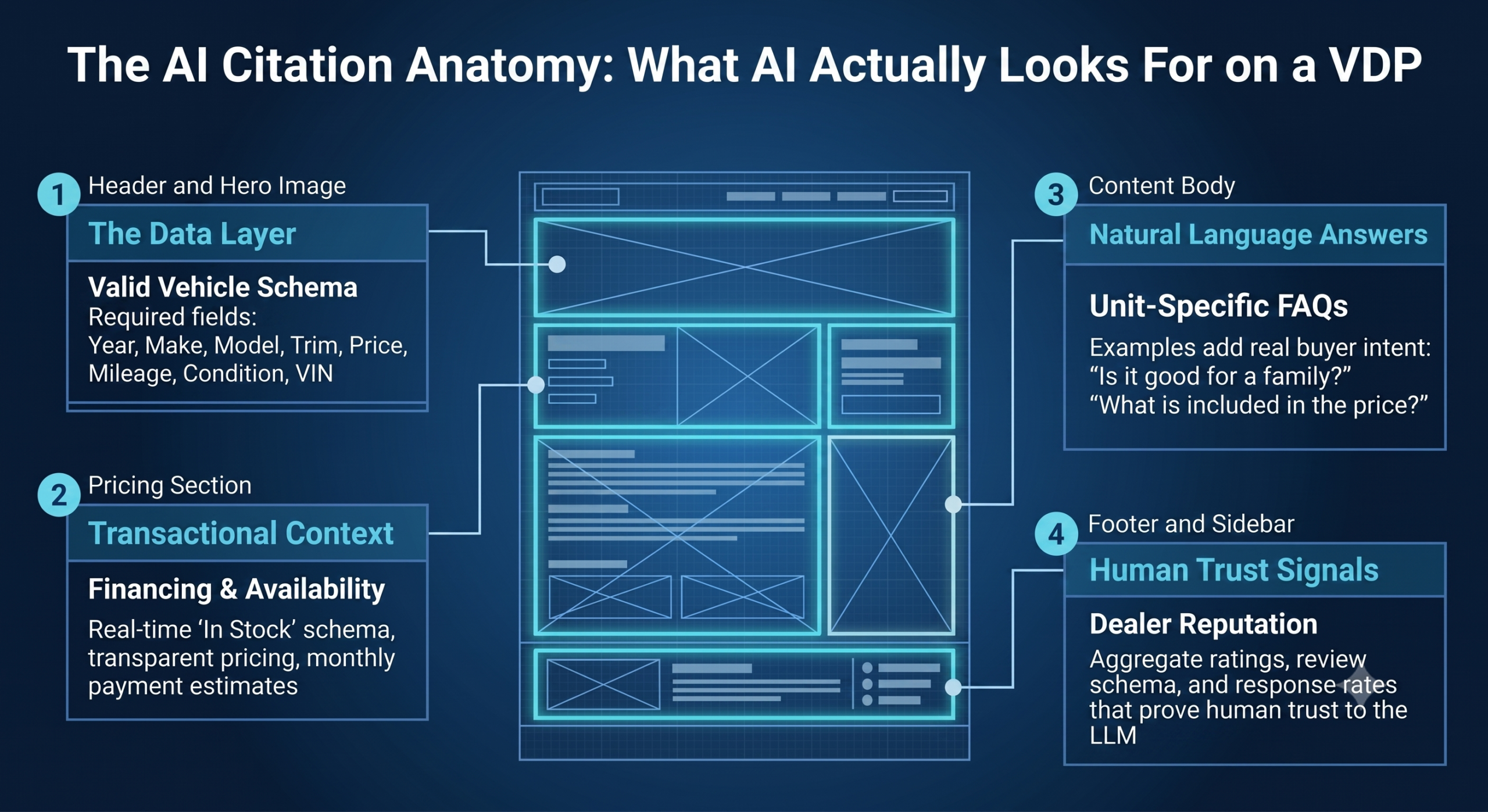
Google says its AI features use the same broad SEO fundamentals as Search: pages need to be crawlable, indexable, eligible for snippets, internally discoverable, and supported by visible text. Google’s AI guidance also describes retrieval-augmented generation and query fan-out, which means one shopper question can trigger multiple related searches before an AI answer is assembled.
For automotive inventory, this creates a straightforward rule: every VDP should behave like a clean evidence page for that exact vehicle. The page should answer what the vehicle is, where it is, what it costs, whether it is available, why it matters, and which buyer it fits.
Thin VDP Problem
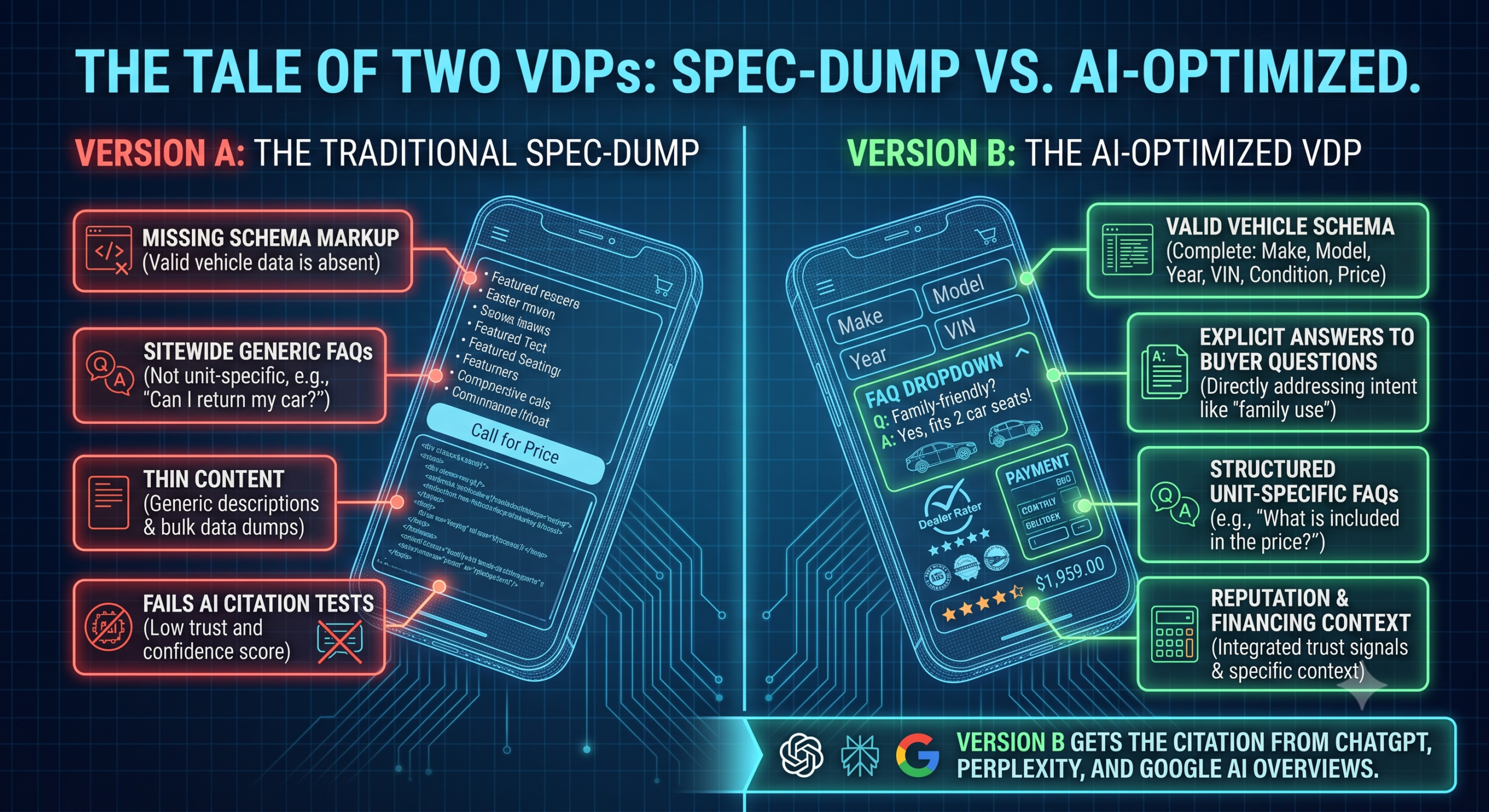
Most dealership VDPs are built from thin templates: a photo carousel, price, mileage, payment widget, feature list, disclaimer, lead form, and a paragraph of copy that could describe almost any vehicle on the lot. That may be enough for a VIN search. It is not enough to become the source an AI assistant cites when a shopper asks a nuanced commercial question.
AI citations tend to favor pages that provide specific, current, extractable answers. A better VDP should help answer questions like:
- Is this used AWD SUV a good fit for winter commuting?
- Which used trucks near Burlington have a tow package?
- Does this specific F-150 have service records, clean title language, and the right configuration?
- What makes this 2022 CR-V different from similar units?
- Is this vehicle still available, and when was the page last updated?
The goal is not to inflate the page. The goal is to make the page useful enough that an AI system can cite it without needing to guess. Guessing is not a business model. It is just a lead-quality problem wearing a futuristic hat.
Crawlability Checks
Before improving the content, make sure AI and search systems can actually reach the page. For Google, a VDP needs to be indexed and eligible to show a snippet. Avoid accidental noindex, blocked JavaScript content, or preview restrictions such as nosnippet if the goal is citation visibility.
For ChatGPT search visibility, review OpenAI crawlers and allow OAI-SearchBot where appropriate. For Perplexity, review Perplexity crawlers and confirm that PerplexityBot is not blocked in robots.txt or by the CDN. For Bing and Copilot visibility, use clean XML sitemaps and sitemap guidance with accurate freshness signals.
A basic AI-search-friendly crawler configuration might look like this:
User-agent: OAI-SearchBot
Allow: /

User-agent: PerplexityBot
Allow: /

User-agent: *
Disallow: /wp-admin/
Allow: /wp-admin/admin-ajax.php
This is only a starting point. The real audit should also check server logs, CDN firewall rules, rendered HTML, canonical tags, sitemap inclusion, and whether the most important VDP content is present in crawlable text.
Automotive Schema
Structured data will not magically force an AI citation, but it can reduce ambiguity. For VDPs, use JSON-LD to describe the vehicle, the offer, and the selling dealership. Google’s Product markup documentation explains how product data can communicate price, availability, reviews, and related information. Schema.org’s automotive schema provides vehicle-specific properties such as VIN, mileage, drivetrain, fuel type, transmission, body type, interior color, and model year.
One important caveat: Google phased out support for Vehicle Listing rich results as part of a broader structured data update. That does not mean vehicle schema is useless. It means the strategy should not depend on a deprecated rich-result treatment. Use schema to clarify the entity, not to chase a retired SERP costume.
For a VDP, the core schema entities are usually Car or Vehicle, Offer, and AutoDealer. The Schema.org Car type sits under Product and Vehicle, while the AutoDealer type identifies the dealership as a local automotive business.
{
  "@context": "https://schema.org",
  "@type": "Car",
  "name": "2021 Toyota RAV4 XLE AWD",
  "brand": {
    "@type": "Brand",
    "name": "Toyota"
  },
  "model": "RAV4 XLE AWD",
  "vehicleModelDate": "2021",
  "vehicleIdentificationNumber": "REPLACE_WITH_VIN",
  "sku": "REPLACE_WITH_STOCK_NUMBER",
  "mileageFromOdometer": {
    "@type": "QuantitativeValue",
    "value": 48215,
    "unitText": "miles"
  },
  "driveWheelConfiguration": "https://schema.org/AllWheelDriveConfiguration",
  "fuelType": "Gasoline",
  "vehicleTransmission": "Automatic",
  "bodyType": "SUV",
  "color": "Magnetic Gray Metallic",
  "vehicleInteriorColor": "Black",
  "image": [
    "https://example.com/path/to/vehicle-photo.jpg"
  ],
  "offers": {
    "@type": "Offer",
    "url": "https://example.com/inventory/2021-toyota-rav4-xle-awd",
    "priceCurrency": "USD",
    "price": "23995",
    "availability": "https://schema.org/InStock",
    "itemCondition": "https://schema.org/UsedCondition",
    "seller": {
      "@type": "AutoDealer",
      "name": "Example Toyota",
      "address": {
        "@type": "PostalAddress",
        "streetAddress": "123 Main Street",
        "addressLocality": "Burlington",
        "addressRegion": "VT",
        "postalCode": "05401",
        "addressCountry": "US"
      }
    }
  }
}
The schema must match the visible page. Do not put claims like “one owner,” “certified,” “clean history,” “available,” or a lower price in JSON-LD unless those details are visible and accurate on the VDP. Misaligned schema is not optimization. It is a liability with curly braces.
Citable Summaries
Every important VDP should include a short, factual summary near the top of the page. This summary should be written for humans, but structured so an AI system can lift it as a standalone answer. It should include the year, make, model, trim, mileage, drivetrain, key features, price, date, dealership location, and buyer fit.
Use a block like this:
Quick answer

This [year make model trim] is currently available at [dealer] in [city, state] for [price] as of [date]. It has [mileage] miles, [drivetrain], [engine/fuel type], and key features including [feature 1], [feature 2], and [feature 3]. It is best suited for [buyer/use case], especially buyers comparing [vehicle category] near [location].
Example:
Quick answer

This 2021 Toyota RAV4 XLE AWD is currently available at Example Toyota in Burlington, Vermont for $23,995 as of July 2, 2026. It has 48,215 miles, all-wheel drive, a 2.5L gas engine, and key features including blind-spot monitoring, heated seats, Apple CarPlay, and adaptive cruise control. It is best suited for buyers looking for a compact AWD SUV for winter commuting, fuel efficiency, and daily family use near Burlington.
This is the difference between inventory copy and citation copy. Inventory copy says the vehicle exists. Citation copy gives the AI system a safe answer.
VIN-Specific Proof
The strongest VDP content is specific to the vehicle, not copied across the inventory feed. Add a section called “Why this vehicle stands out” and use facts that are true for that VIN. Good examples include ownership history, service records, certification status, reconditioning notes, tire condition, brake condition, accident disclosure, warranty coverage, OEM packages, and inspection status.
Do not merely list features. Interpret them. For example, “Subaru EyeSight” is a feature label. “Subaru EyeSight with adaptive cruise control and lane centering is useful for long highway commuting” is a buyer-relevant statement. The second version is easier for an AI system to use when a shopper asks whether the vehicle fits a specific use case.
| Weak VDP Copy | AI-Citable VDP Copy |
|---|---|
| Loaded with features. | This 2021 RAV4 XLE AWD includes blind-spot monitoring, heated seats, Apple CarPlay, adaptive cruise control, and all-wheel drive. |
| Great in the snow. | Its all-wheel-drive configuration makes it a practical fit for winter commuting in Vermont and other snow-prone markets. |
| Won’t last long. | The page was last updated on July 2, 2026, and the vehicle is listed as available at the Burlington showroom. |
Page Structure
AI systems and crawlers reward clarity. A VDP should have clean headings, visible text, crawlable tables, and sections that map to actual buyer questions. Bing’s AI Performance guidance specifically points to headings, tables, FAQs, evidence, and freshness as ways to make content easier for AI systems to reference accurately.
A strong VDP structure looks like this:
H1: Used 2021 Toyota RAV4 XLE AWD for Sale in Burlington, VT

Quick answer

Key specs table

Why this vehicle stands out

Condition and history

Best fit

Pricing and availability

Dealer location

FAQs
The key specs table should include the fields that both humans and machines need to verify the listing:
| Field | Why It Matters |
|---|---|
| VIN | Identifies the exact vehicle and reduces ambiguity. |
| Stock number | Helps connect the website, CRM, and inventory system. |
| Price | Supports commercial comparison queries. |
| Mileage | Helps AI systems compare similar used vehicles. |
| Availability | Prevents stale answers and wasted leads. |
| Last updated | Signals freshness for high-churn inventory pages. |
| Dealer location | Supports local and near-me buyer intent. |
Use tables for facts and prose for judgment. Tables make the data extractable. Prose explains why the data matters.
Inventory Freshness
Automotive VDPs are perishable pages. A stale VDP can produce bad AI answers, poor user experience, and weak lead quality. Price, mileage, availability, incentives, and sold status need to stay in sync across the visible page, schema, sitemap, inventory feed, and CRM.
Use XML sitemaps with accurate lastmod values. Bing’s sitemap guidance says lastmod should reflect the true modification time of the page content, not the time the sitemap was generated. For fast-changing inventory, pair sitemaps with IndexNow so participating search engines can be notified when URLs are added, updated, or removed.
<url>
  <loc>https://example.com/inventory/2021-toyota-rav4-xle-awd</loc>
  <lastmod>2026-07-02T14:35:00-04:00</lastmod>
</url>
The operational rules are simple:
- Show a visible “last updated” date on the VDP.
- Update
lastmodonly when page content actually changes. - Mark sold vehicles as sold immediately.
- Remove, redirect, or noindex sold VDPs when they no longer serve searchers.
- Keep visible price, offer schema, and inventory feed data synchronized.
Local Entity Signals
Most vehicle shopping queries have local intent, even when the shopper does not explicitly say “near me.” The VDP should connect the vehicle to the dealership entity with consistent name, address, phone number, hours, map data, review profile, and sales contact information.
Google’s AI guidance notes that generative AI responses can include product and local business information, and it points businesses toward Merchant Center and Google Business Profiles. Bing also recommends Bing Places for local businesses so address, hours, and contact details remain current for AI-generated responses.
For dealer websites, the VDP should include:
- Dealership name
- Street address
- Phone number
- Sales hours
- Map or location context
- Review links
- Department contact information
- Local service area references where natural
The point is to make the dealership-vehicle-location relationship unmistakable. AI systems should not have to infer that a specific used SUV is available at a specific store in a specific market. The page should say it plainly.
Inventory Hubs
Individual VDPs churn quickly. Stable inventory hub pages can earn AI citations for broader buyer questions while passing users to the right VDP. These pages should summarize live inventory, answer category-level questions, and link to relevant vehicles.
Good examples include:
- Used AWD SUVs under $25,000 in Burlington, VT
- Certified pre-owned Toyota RAV4s in Vermont
- Used trucks with tow packages near Burlington
- Used Subaru Outbacks for winter driving
- Used EVs and plug-in hybrids in Vermont
These pages should not be doorway spam. They need real inventory, buyer guidance, local context, and clear internal links. Done well, the hub page wins the category-level citation and the VDP wins the VIN-level citation.
Measurement Plan
AI citation performance should be measured separately from rankings. Start with platform-native tools where available, then add manual prompt testing and log analysis.
Google launched AI reports in Search Console for generative AI features such as AI Overviews and AI Mode, with rollout limited to a subset of sites during testing. Bing’s AI Performance reporting shows cited pages, citation activity, visibility trends, and grounding queries across supported Microsoft AI experiences.
Track these inputs monthly:
- Search Console: Watch generative AI impressions and cited pages where reports are available.
- Bing Webmaster Tools: Review AI citations, cited URLs, and grounding queries.
- Server logs: Monitor Googlebot, Bingbot,
OAI-SearchBot, andPerplexityBotactivity. - Prompt testing: Run the same buyer prompts in Google, ChatGPT, Perplexity, and Copilot each month.
- Referral traffic: Track AI-search referrals, but do not rely on clicks alone. Citations can influence shoppers before they click.
Implementation Priority
Do not try to boil the inventory ocean. Start with the VDP elements that affect retrievability, trust, and freshness first.
- Crawlability audit: Confirm Googlebot, Bingbot,
OAI-SearchBot, andPerplexityBotcan access VDPs. Check for blocked rendering, accidentalnoindex, accidentalnosnippet, canonical problems, and CDN firewall issues. - VDP data standardization: Make VIN, stock number, price, mileage, availability, location, vehicle history, and last updated date visible on the page.
- JSON-LD cleanup: Add or validate
CarorVehicle,Offer, andAutoDealerschema. Keep it synced with visible content. - Unique summary copy: Add a “Quick answer” section and a “Why this vehicle stands out” section to priority VDP templates.
- Inventory freshness: Use accurate XML sitemap
lastmodvalues, IndexNow, and clear sold-vehicle handling. - Stable inventory hubs: Build model, category, price, and location pages that summarize live inventory and link to VDPs.
- AI visibility tracking: Monitor Google AI reports, Bing AI Performance, server logs, manual prompts, and referral traffic.
The best automotive VDPs are no longer just listing pages. They are structured, current, locally grounded evidence pages for specific vehicles. That is what makes them useful to shoppers, understandable to crawlers, and safe for AI systems to cite.
Vehicle Detail Pages, GEO-FAQ
What is an AI citation for an automotive VDP?
An AI citation happens when an AI-powered search experience or answer engine uses a vehicle detail page as a supporting source in its answer. For automotive inventory, this usually means the VDP provided clear facts about a specific vehicle, such as price, mileage, availability, location, features, condition, or buyer fit.
Do VDPs need schema to earn AI citations?
Schema is not a guarantee of AI citations, but it helps clarify the vehicle, offer, and dealership entity. For automotive VDPs, Car or Vehicle, Offer, and AutoDealer schema are useful when they accurately match the visible page content.
Should dealerships still use Vehicle schema after Google phased out Vehicle Listing rich results?
Yes, but expectations should change. Vehicle Listing rich results are no longer the goal in Google Search. The value of vehicle schema is now entity clarity, data consistency, and machine-readable support for the exact vehicle being sold.
What is the most important VDP content for AI citations?
The most important content is a concise, factual vehicle summary that includes the year, make, model, trim, price, mileage, availability, dealership location, last updated date, and buyer fit. A VDP should also include VIN-specific proof such as history, condition, certification, packages, and reconditioning details.
How should sold vehicle pages be handled?
Sold vehicles should be marked as sold immediately. If the page no longer helps shoppers, remove it, redirect it to a relevant inventory page, or use noindex. The wrong move is leaving a sold vehicle marked as available, because AI systems and shoppers may continue to treat the listing as current.
How can dealerships measure AI citation visibility?
Dealerships should combine Search Console generative AI data where available, Bing Webmaster Tools AI Performance data, server log analysis, manual prompt testing, and referral traffic tracking. Rankings alone do not show whether AI systems are citing, summarizing, or ignoring inventory pages.
 Why AI Won’t Recommend Your VDP: The Three-Layer GEO Fix