
Automotive Generative Engine Optimization (GEO) requires dealerships to structure their Vehicle Detail Pages (VDPs) and model landing pages so AI engines can access, understand, and confidently recommend specific inventory to buyers. Written by Chris Nichols of Fast Frigate Digital Marketing, this guide explains why most dealer VDPs fail AI citation tests due to missing technical fundamentals or generic spec-dump content. You must solve three sequential layers – machine trust, comprehension, and recommendation confidence – to turn your inventory pages into verifiable sources that ChatGPT, Perplexity, and Google AI Overviews will actually cite.
I have spent over a decade staring at Vehicle Detail Pages. I have watched them evolve from static HTML brochures into massive, JavaScript-heavy applications that track every mouse movement. Now we are watching them fail a completely new test.
A buyer runs a Google search or opens ChatGPT and asks a very specific question: “What is the towing capacity of a 2024 Silverado 1500 LT, and which dealers near me have one in stock?” The AI does not recommend your dealership. It recommends a competitor across town. Your VDP has the truck. Your VDP has the towing capacity listed somewhere in a massive table of specs. But the machine skipped you. Most dealership SEO strategies assume this is a content problem. They assume they need to write more blog posts. That assumption is wrong. The problem is your VDP architecture.
If you want an AI to confidently recommend a specific unit in a conversational response, your VDP must satisfy three distinct confidence layers. You cannot skip a layer. You cannot fake a layer.
What Lies Beneath…
- The Sequencing Argument
- Layer One: Machine Trust
- Layer Two: Comprehension
- Layer Three: Recommendation Confidence
- Recommendation Confidence Doesn’t Stop at Your Page
- Frequently Asked Questions
- The Bottom Line
The Sequencing Argument
Every month brings a new wave of vendors selling an automation layer that promises to magically trick AI into picking your tired website. Time will tell how that plays out. My money is on AI being smart enough to find real content depth over window dressing. Good SEO still wins. Good SEO is good Search Everywhere Optimization.
The gap between most current VDPs and what an AI needs to see is vast. But the failure points are predictable. You have to think about AI citation as a sequence of dependencies.
Speed gets the page into the conversation. Schema gives the machine a map. Natural language gives the machine something useful to say.
If the machine trust layer is broken, the comprehension layer may never get a fair shot. If the machine trust layer is solved and the VDP is still just a spec dump, the AI can access the page but has very little reason to recommend that specific unit. You have to build the infrastructure in order.
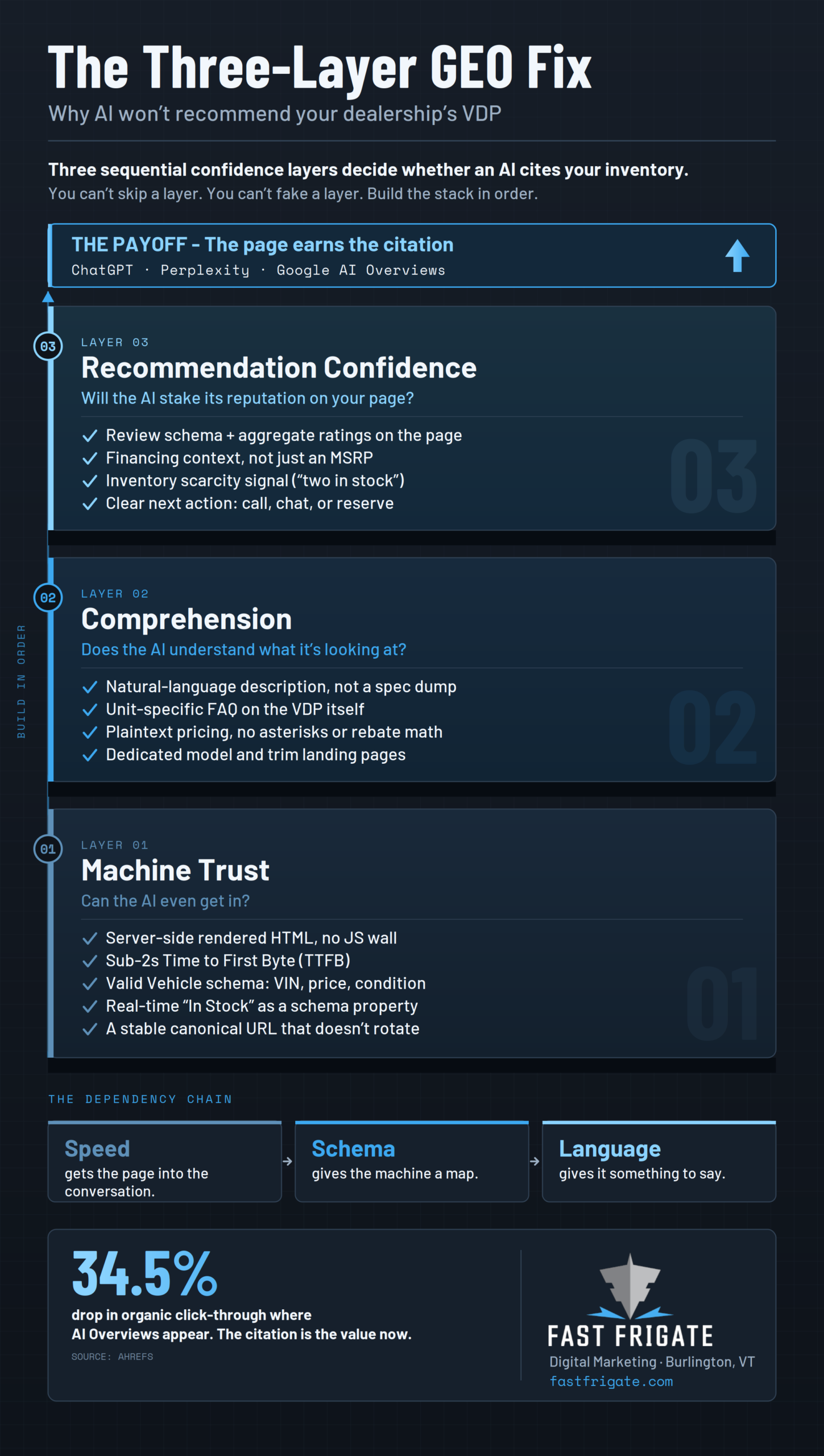
Layer One: Machine Trust
Can the AI even get in? That is the only question that matters at layer one. Most dealers do not control this layer. Their website platform controls it. And many of those platforms are failing.
To pass the machine trust layer, your VDP needs server-side rendered HTML. If your inventory is hidden behind a JavaScript framework wall, many AI crawlers will simply bounce. They do not have the time or the render budget to execute heavy client-side scripts just to see if a car is in stock. They need sub-two second Time to First Byte (TTFB). Crawl budget goes to fast pages first.
You need valid Vehicle schema with every major field populated. Make, model, year, trim, mileage, price, availability status, VIN, and condition. That availability status needs to update in real time. “In Stock” must be a schema property, not just text painted on the page. You need a canonical URL that does not rotate or expire the moment a vehicle moves from the front lot to the back lot.
If your third-party pixel stack is competing with your own content for bandwidth, CPU, and render time, you are making the machine trust layer harder than it should be. The AI needs a clean, fast, structured map of the vehicle. If it cannot find one, it moves on.
Layer Two: Comprehension
Does the AI understand what it is looking at? This is the layer where almost every dealership fails. The gap between most current VDPs and a citation-ready page is almost entirely layer two.
Layer two is pure content and presentation. Most VDPs are just spec dumps. A bulleted list of features exported directly from the OEM data feed. A spec dump is not a recommendation. A spec dump is raw data.
You need a natural language description paragraph that reads like a knowledgeable salesperson wrote it. “This 2024 Silverado 1500 LT is well-suited for towing up to 11,000 lbs and comes with the factory tow package already installed” beats a bullet list of specs every time. The AI can parse that sentence. It understands the relationship between the truck, the capability, and the installed package.
You need explicit answers to the questions AI shoppers actually ask. Is it good for a family? Does it fit a car seat? What is the payment at current rates? What is included in the price? You need a structured FAQ section on the VDP itself. Not a sitewide FAQ. A unit-specific FAQ. We covered the mechanics of this in our guide on why Google killed FAQ rich results. The visual dropdowns are gone, but the structured data layer is exactly what AI engines use to extract answers.
The same logic applies to your model and trim landing pages – not just individual unit VDPs. A dedicated “2024 Silverado 1500” page that answers comparison questions, explains trim differences, and addresses real buyer intent is one of the highest-leverage pages on your site for AI citation. Industry research consistently shows model-specific pages account for a significant share of AI Overview citations in automotive. If you do not have them, or if they are thin, that is a gap worth closing before you spend another dollar on paid media.
You need plaintext pricing with no asterisks or obfuscation. AI models lose confidence on ambiguous pricing. If your price requires a human to decipher three different conditional rebates, the machine will skip it and cite a dealer with a clear number.
Layer Three: Recommendation Confidence
Will the AI stake its reputation on your page? That is the final test. An AI engine does not want to recommend a dead end. It does not want to send a user to a dealership with a terrible reputation.
You need dealer reputation signals on the page itself. Review schema, aggregate ratings, and response rates. The machine looks for validation that other humans trust this entity. You need financing context. A monthly payment estimate gives the AI a complete picture of the transaction, rather than just an MSRP.
You need an inventory scarcity signal. “Two in stock” is a much stronger signal than no quantity context at all. You need clear next actions. A phone number, a chat interface, or a reserve button. The AI wants to provide a complete answer that leads to a resolution.
This ties directly into your broader technical foundation. We outlined how this works in our guide to the brand entity stack. Your VDP does not exist in a vacuum. It is part of your dealership’s larger entity footprint. If the AI trusts the entity, it is far more likely to trust the specific vehicle recommendation.
One thing worth knowing: you can actually observe ChatGPT’s citation decision-making process in real time. I built a Chrome DevTools script that intercepts ChatGPT’s internal API during a live conversation and surfaces the full search intelligence report – every fan-out query the model ran, the reasoning chain it followed, which pages it opened, and exactly which URLs it cited. Running it against a dealer-specific query is instructive. You can see the model run multiple search rounds, read specific pages, and make deliberate citation choices. The pages that get cited are not the ones with the most content. They are the ones where the machine found the clearest, most structured answer to the question it was trying to resolve.
Recommendation Confidence Doesn’t Stop at Your Page
Everything above happens on your VDP. The final question does not. When a buyer asks an AI which dealer to actually buy from, the machine settles that answer inside an ecosystem you do not own. This is the part dealers most want to be untrue, and it is the part the data is most blunt about.
AirOps, in its 2026 State of AI Search report, found that roughly 85 percent of brand mentions in AI-generated answers come from third-party domains and only about 15 percent from a brand’s own site. Hold that against everything above. Your VDP is the 15 percent. The other 85 percent is happening on properties you can influence but cannot control.
Start with the pipe. ChatGPT resolves its live searches through Bing, so a dealership that is invisible in Bing is invisible in ChatGPT no matter how clean the VDP is. Most dealers never check. Then the machine cross-references. For a commercial “which dealer” query, engines weight independent validation over your own marketing copy: Google reviews, DealerRater, Cars.com, and open community discussion.
You cannot schema your way past a bad reputation. The page tells the machine what you are selling. The ecosystem tells the machine whether to trust you.
Reddit earns its own paragraph. Profound’s analysis of AI citation patterns shows how heavily conversational engines lean on it as a source, with Perplexity drawing close to half of its citations from Reddit alone. Engines read it as candid, independent signal. A genuine presence in the right automotive subreddits and owner forums carries real citation weight. It also cannot be faked. Engines and communities have both gotten good at spotting manufactured activity, and getting caught costs more than being absent. The move is sustained, honest participation, not astroturf.
Off-page is not only upside. BrightEdge, analyzing hundreds of millions of prompts, found Google AI Overviews roughly 44 percent more likely to surface negative brand sentiment than ChatGPT. Unmanaged negatives get amplified at the precise top-of-funnel moment a buyer is forming an opinion, before they ever reach your lot. Review volume, recency, and response rate are load-bearing, and your name, address, and phone number have to match across every profile and directory. We covered why that consistency matters in our guide to the brand entity stack.
None of this replaces the three layers. It is the soil they grow in. A citation-ready VDP sitting inside a neglected off-page footprint still loses the recommendation to the dealer across town whose reputation the machine already trusts. Build the page. Then go build the evidence around it.
Frequently Asked Questions
What is the biggest mistake dealers make with VDP optimization?
Most dealers rely entirely on the automated descriptions provided by their website platform. Those descriptions are duplicated across hundreds of other dealership websites. AI engines filter out duplicate content and look for unique, natural language descriptions that add specific context to the vehicle.
How does page speed affect AI citations?
AI crawlers allocate their crawl budget based on efficiency. If your VDP has a slow Time to First Byte (TTFB) or is weighed down by excessive third-party tracking scripts, the crawler may abandon the page before fully indexing the inventory data or schema markup.
Do I need schema markup on every VDP?
Yes. Valid Vehicle schema is non-negotiable for AI visibility. It translates your page content into a machine-readable format. You must populate the critical fields, including VIN, price, condition, and real-time availability status, to pass the machine trust layer.
Should I also create dedicated model landing pages?
Yes, and they are often a higher-leverage investment than optimizing individual VDPs. A well-built “2024 Ford F-150” landing page that answers comparison questions, explains trim differences, and addresses buyer intent can earn AI citations for every unit on your lot that matches the query – not just one.
Can I just use AI to write my VDP descriptions?
You can use AI to assist in drafting, but the output must be factual, specific to that exact unit, and free of generic marketing fluff. The goal is to provide clear answers to buyer questions, like towing capacity or family suitability, not just to fill space with adjectives.
Can on-page VDP changes alone get my inventory cited?
No. On-page work makes a VDP citable, but for dealer-recommendation queries the AI leans heavily on off-page validation like reviews and community mentions. AirOps reports that roughly 85 percent of AI answer mentions come from third-party sources. Build the page, then build the reputation around it.
The Bottom Line
We have been testing this framework on live dealer builds. The clean architecture consistently tests at 95 or higher across the major lab categories. Real-world field data shows stable Core Web Vitals at the origin level – and AI Overviews reduce click-through rates to organic results by 34.5%, which means the citation is where the value now lives. The legacy stacks continue to struggle with mobile performance and technical debt.
The lesson is not that better descriptions alone beat standard VDPs. The lesson is that you have to build the whole stack, on the page and off it. If the machine trust layer is broken, the comprehension layer never gets a fair shot. If the page is fast but the actual vehicle content is incomplete or generic, the machine has weak evidence.
Same inventory, same schema. Version A is a traditional spec-dump VDP. Version B has natural language, unit-specific FAQs, clear pricing, and stronger trust signals. Version B gets the citation.
I have spent over a decade watching dealerships leave citations on the table – first from inside the industry, now from the outside with a PageSpeed report in one hand and a schema validator in the other. The data is clear. Build the three layers. Do the work.
 Google Just Killed FAQ Rich Results: What It Means for Your Schema