
Tracking AI search visibility means measuring how often, how accurately, and in what context generative AI systems like ChatGPT, Google AI Overviews, Perplexity, and Claude reference your brand in their answers. For B2B marketers, this matters since pipeline is starting to come from conversations you never see in Google Analytics. This guide from Fast Frigate lays out a seven-step approach any B2B team can run without buying another platform, then expands into the tooling and team-ops questions that come right after.
What Lies Beneath…
The Real Problem with How Most Teams Track AI Visibility
Most B2B marketing team members have a Google Search Console tab open right now. They check rankings weekly, they run a rank tracker, they probably pay for Ahrefs or Semrush, and none of that tells them whether ChatGPT mentioned them yesterday during a 14-message buyer conversation that ended with the prospect picking a competitor. That’s the gap. It’s getting wider every quarter.

The current state of B2B search has three layers stacked on top of each other now. Classic blue links. AI Overviews and SGE-style synthesized answers in Google. Conversational AI search inside ChatGPT, Perplexity, Claude, and Gemini happening completely outside any analytics tool you own. Each layer has different rules for who gets cited and why, each rewards different on-page signals, and only one of them, the first, shows up cleanly in your existing reporting. When a CMO asks “how are we doing in AI search,” most teams either guess or quietly pivot the question. The teams that don’t pivot are the ones who built tracking before the question came up.
You can actually track this. You don’t need a $30k/year platform to start, the methodology is straightforward once someone walks you through it, and the seven steps below are what we use at Fast Frigate when a new B2B client comes in asking whether their brand is showing up where it counts. Some clients hand this off to their internal team after we set it up. Some have us run it monthly. Either way, the framework stays the same, and any in-house team can run it once the structure is clear.
One quick caveat before getting into it. Nobody has fully solved this yet, including the platforms charging enterprise prices for it. The data sources are inconsistent, the AI engines keep changing their citation logic, and what was reliable in January 2025 isn’t reliable now. Treat this as a working method, not a finished science. It’s good enough to inform real decisions, which is more than most teams currently have.
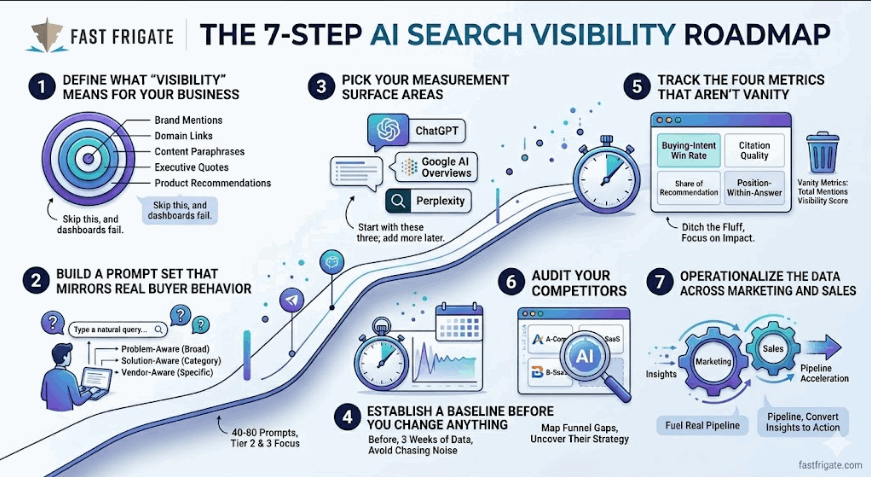
Step 1: Define What “Visibility” Actually Means for Your Business
Before tracking anything, the team has to agree on what counts as a “mention.” This is the step almost everyone skips, and it’s the step that determines whether your tracking ends up useful or just a number that goes up and down with no clear meaning. Getting this wrong upstream means every downstream metric inherits the confusion. Getting it right takes about an hour of conversation. There are at least five different definitions floating around in the B2B marketing world right now, and most teams have never sat down to pick which ones count for them:
- The AI answer mentions your brand name verbatim
- The AI answer links to a URL on your domain
- The AI answer paraphrases content that originated on your site without crediting you
- The AI answer surfaces a quote attributed to one of your executives or thought leaders
- The AI answer recommends your product or service category in a way that benefits you
These are not the same thing, they have different commercial value, they have different optimization paths, and mixing them together in one “AI visibility score” is how you end up with a dashboard that looks great and means nothing. The five definitions above tend to get compressed into a single number by tooling vendors. That compression is where the signal dies. For most B2B companies, the order of commercial importance runs roughly: a recommendation in a buying-intent prompt comes first, then a direct domain citation, then a verbatim brand mention, then an executive quote attribution, then an uncredited paraphrase. Pick which ones matter, weight them honestly, and write the definitions down somewhere your whole team can see. Without this, every other step in the framework loses its anchor.
Most teams don’t take the time. They jump to tooling. Six months later they’re staring at a graph nobody can read.
Step 2: Build a Prompt Set That Mirrors Real Buyer Behavior
This is the list of questions you’re going to put into AI engines and check whether your brand appears, and the quality of this list determines the quality of everything downstream. Bad prompt sets look like keyword lists. Good prompt sets look like questions an actual buyer would type or speak into ChatGPT during a real buying process. The difference matters a lot. AI engines respond very differently to “B2B marketing analytics platforms” (a keyword) versus “what’s a good marketing analytics tool for a 200-person B2B SaaS company that uses HubSpot” (a buyer query). Your prompts need to live in the second pattern, not the first.
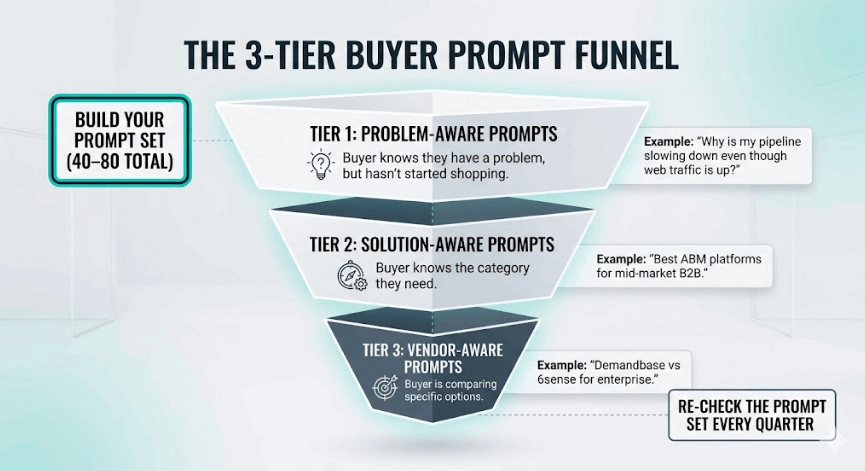
Build the prompt set in three tiers. First tier is what we call problem-aware prompts, where the buyer knows they have a problem but hasn’t started shopping yet. “Why is my pipeline slowing down even though web traffic is up?” Second tier is solution-aware prompts, where the buyer knows the category they need. “Best ABM platforms for mid-market B2B.” Third tier is vendor-aware prompts, where the buyer is comparing specific options. “Demandbase vs 6sense for enterprise.”
Aim for 40 to 80 prompts total, weighted heavier toward tiers two and three since that’s where commercial impact lives. A small team with a tight category can do this in an afternoon. Multi-product or multi-vertical teams should plan for two days. Pull from real sales call transcripts where possible, pull from your support ticket questions, pull from the actual searches in your Google Search Console that have buyer intent. Don’t make this up from your head. Your assumptions about what buyers ask are almost always wrong, and the prompt set built from internal guesses tends to flatter the company that built it instead of revealing the real visibility gaps.
The other rule for this step: re-check the prompt set every quarter. Buyer language shifts. Product categories rename themselves. New competitors appear and change the comparison set. A prompt set built in Q1 2025 will be measurably stale by Q4 of the same year.
Step 3: Pick Your Measurement Surface Areas
The fragmentation problem is real. Tracking AI visibility means deciding which AI surfaces you actually care about, since tracking all of them gets expensive and most of them don’t matter equally for B2B. The good news is that you can reasonably ignore most of them in year one and still produce useful tracking. The bad news is that the surface mix changes every six months as user behavior shifts. So the list below is a snapshot, not a permanent answer, and the team that owns this needs to re-evaluate the mix at least twice a year. Here are the big surfaces, in rough order of B2B relevance as of mid-2025:
- ChatGPT (OpenAI). Highest user volume across both consumer and B2B contexts. Cites web sources inconsistently but increasingly often. Tracking here is required, not optional.
- Google AI Overviews. The synthesized answer block at the top of Google SERPs for many queries. Tied directly to your existing organic SEO performance. If you’re winning traditional SEO, you have a head start; if you’re losing, this hurts twice over since the AI Overview cannibalizes the clicks your link would have gotten.
- Perplexity. Smaller user base but heavily skewed toward technical and B2B decision-makers. Citation-forward by design, which makes it the easiest surface to track reliably.
- Claude (Anthropic) and Gemini (Google). Growing fast in B2B contexts, Claude particularly. Citation behavior is less predictable than Perplexity but more predictable than ChatGPT.
- Microsoft Copilot. Embedded in Office and Bing. Lower share-of-search but disproportionately important if your buyer is enterprise.
For most B2B companies starting from scratch, begin with ChatGPT, AI Overviews, and Perplexity. Add the others once your tracking workflow is mature. Trying to track six surfaces from day one will burn out your team and produce data nobody trusts.
Some teams ask why we don’t include AI mode in Google as its own line item. We do track it, but it folds into the AI Overviews tracking workflow since the surface area shares a lot of underlying logic. Tracking it as a separate workstream is overkill for most B2B teams in year one.
Step 4: Establish a Baseline Before You Change Anything
This is where teams blow themselves up. They start optimizing before they’ve measured. A month in, when someone asks “did it work?”, there’s no clean before-after comparison and the whole investment becomes a story rather than a result. Baselines feel boring and skippable when you’re excited to start optimizing, which is exactly why they get skipped. Then teams spend a year not really knowing if anything is working.
The baseline is simple to describe and slow to execute. Run every prompt in your prompt set, in every surface area you chose, in a controlled way, and record what comes back. Do it once. Do it again a week later. Do it again a week after that. You’ll see variance even when nothing has changed, since the AI engines are non-deterministic. The point of the baseline is to know what your normal range looks like before you try to move it, which means you need at least three weeks of data before any optimization activity begins. Anything less and you’re chasing noise.
A useful baseline captures whether your brand appeared at all, where in the answer it appeared (first sentence, somewhere in the middle, last paragraph, or as a citation only), what was said about it, what other brands were mentioned alongside, and whether any URL from your domain was linked. Six fields per prompt-surface combination. That’s it. If your prompt set is 60 prompts and you’re tracking three surfaces, that’s 180 data points per run. Doable manually for the first month as you build the muscle. After that, you’ll want at least partial automation since the manual approach doesn’t scale and the data quality degrades when humans do repetitive entry work. More on tooling further down.
The honest version: most teams won’t do this step properly. They’ll skim it and move to optimization. Discipline at the baseline pays compounding dividends across the next twelve months.
Step 5: Track the Four Metrics That Aren’t Vanity
There’s a long list of metrics you could track. Most of them are vanity. Mention count by itself is vanity. Total citations across all platforms is vanity. “Visibility score” calculated as an average is almost always vanity, since the underlying definitions are mixed. The four metrics below are the ones we’ve seen track cleanly against pipeline movement at B2B clients across a range of categories. Other metrics have a place as supporting diagnostics. None should be your headline number except these:
- 1. Buying-Intent Prompt Win Rate. Of your tier-three prompts (the vendor-aware ones, “X vs Y,” “best [category] for [use case]”), what percentage mention your brand favorably? This is the closest thing AI search has to a conversion metric. If this number is moving up, real pipeline impact follows. If it’s moving down, you have a problem that won’t show up in your other reporting for another two quarters.
- 2. Citation Quality, Not Quantity. When your domain is cited, what page is cited? Is it your pillar content, your product pages, or some old blog post you forgot existed? Quality citations track with quality conversations. Junk citations track with the AI not knowing what to do with your site.
- 3. Share of Recommendation vs Top 3 Competitors. Pick your three most direct competitors. For every relevant buying-intent prompt, track how often each of you is mentioned. The absolute number matters less than the relative trajectory. If competitor X is gaining share in vendor-aware prompts and you’re not, you have a problem regardless of your absolute numbers.
- 4. Position-Within-Answer. Being mentioned first in an AI response is meaningfully more valuable than being mentioned last. This is the AI equivalent of position in a SERP. Track where in the answer your brand falls. We have seen position-within-answer shifts predict pipeline changes by four to six weeks.
What’s not on this list: total mention count, “AI visibility score” averages, raw citation counts, social-style sentiment scores. None of these track cleanly with revenue. If a vendor is showing you those as their headline metrics, ask harder questions before signing the contract.
A quick aside that should be obvious but apparently isn’t: tracking metrics is not the same as moving them. Plenty of teams have beautiful dashboards and zero strategy for changing what the dashboards show. The metrics are diagnostics. Step 7 is where action happens.
Step 6: Audit Your Competitors Inside the Same AI Surfaces
Competitor visibility is one of the highest-value signals you can pull out of AI search tracking, and most teams never look at it. The reasoning is “we want to track ourselves,” which sounds disciplined but actually leaves money on the table. When you run your prompt set, the AI engines aren’t just deciding whether to mention you, they’re picking from a pool of possible brands. Watching which competitors get picked, in which prompts, gives you a map of where they’re winning that you’d never get from your own analytics. It tells you which competitors the AI considers comparable to you, which is sometimes different from the list your sales team thinks they compete with. That alone is worth the time investment. Here are three patterns worth watching for as you build your competitor tracking:
- Competitors who appear in your tier-one and tier-two prompts but not tier-three. They’re winning the top of the funnel and losing the bottom. Easy to copy what they’re doing at the top, and you can compete on bottom-of-funnel where they’re weak.
- Competitors who appear in tier-three buying-intent prompts where you don’t. This is urgent. They’re being recommended at the decision moment. Figure out why. Usually it’s a combination of comparison content, third-party reviews, and category-defining thought leadership.
- A competitor that suddenly appears across all three tiers when they weren’t there last quarter. Someone over there made a real investment in AI visibility, and you’re going to feel it in pipeline within six months. Worth getting on top of their playbook fast.
The data here is sometimes harder to act on than your own metrics, since you can’t see inside their content strategy. But the directional signal is gold. Use it.
Step 7: Operationalize the Data Across Marketing and Sales
This is the step that separates teams who get value out of AI visibility tracking from teams who just have another dashboard. Tracking is worthless if it sits in a marketing report and never touches anything else. The whole point is to change behavior somewhere in the organization, and behavior change requires that the data reach people who can act on it. Most teams stop at “we made a dashboard.” The dashboard isn’t the deliverable.
What operationalizing looks like in practice: a monthly review where the data goes to content, demand gen, product marketing, and sales leadership at the same time. Not separate reports, one shared view, one shared narrative. The buying-intent win rate from Step 5 is the headline metric, and the conversation is about what’s moving it and what to do next. The review should be 45 minutes maximum. Longer than that and people start checking their phones.
A feedback loop between sales and content matters as much as the review itself. Sales gets the prompts that are working and not working. Content gets the gaps. If three buyers in a row told a sales rep “ChatGPT recommended a competitor over you when I asked about [use case],” that’s a content brief for next week, not a curiosity. Sales enablement updates should incorporate what AI engines are saying about your category. If ChatGPT consistently frames your product category in a particular way, your reps need to know, since that framing is now in your buyer’s head before any conversation starts. The reps who don’t know are walking into meetings already losing.
One specific person needs to own this. Not “everyone’s responsibility.” One owner. Marketing ops is often a good fit. So is the head of content. So is, for some companies, a dedicated AEO/GEO specialist. What doesn’t work: making it everyone’s job, which is the same as making it nobody’s job. Teams that get this right run AI visibility as a cross-functional program, not a marketing reporting exercise. The teams that get it wrong have great data and no behavior change.
How to Track AI Overviews
AI Overviews deserve a dedicated note since they’re the surface most directly tied to your existing SEO investment, and the tracking approach is slightly different from the broader workflow above. For AI Overviews, you’re tracking two things at once: whether an AI Overview appears for the query at all, and if it does, whether your domain is cited within it. The first determines whether AI Overviews are eating your organic clicks for that query. The second determines whether you’re capturing any visibility from the AI Overview when it appears. Both of these have direct revenue implications, and the data sits closer to your existing SEO toolkit than the ChatGPT or Perplexity tracking does, which is why most B2B teams find it easier to start here.
Tools for AI Overview tracking are more mature than tools for ChatGPT or Perplexity tracking, since the data is more deterministic. You can pull this data from Semrush, Ahrefs, Sistrix, and a handful of newer platforms focused on AI Overview tracking. For B2B teams, the practical workflow is a monthly export of your tracked keyword set with AI Overview presence and citation status, compared against your previous month, with attention to high-commercial-intent queries where AI Overview presence is growing.
There’s a separate but related conversation about why AI search cranks impressions but spikes clicks that explains why your GSC numbers might look misleading right now. Worth reading if your impression-to-click ratio has gone sideways in the last six months.

Tools, Platforms, and What to Look For
A lot of platforms have launched in the last 18 months claiming to track AI search visibility. Most are early-stage. Some are good. Almost none are mature solutions yet, which is part of why building your own workflow first usually pays off better than buying. The vendor space is going to shake out a lot over the next two years, and the platforms that survive will be the ones with the most defensible data methodology, not the ones with the slickest dashboards. Today, three categories of tools exist worth knowing about:
- Dedicated AI visibility platforms. Several startups and a few well-funded entrants. Most can track prompt sets across multiple AI engines, but data accuracy varies widely. Spot-check anything they show you before believing it.
- Traditional rank trackers adding AI features. The big SEO platforms have added AI Overview tracking and some are building broader AI visibility features. The data is usually solid for AI Overviews and weaker for ChatGPT and Perplexity tracking.
- DIY approaches. Some teams run their prompt sets through the APIs of major LLMs. OpenAI, Anthropic, and Perplexity all have APIs that allow this. Those teams parse the responses, then build their own tracking in BigQuery or a similar tool. This is more work but produces the cleanest data, since you control the methodology.
If you’re evaluating a platform, here’s what separates the serious vendors from the ones who built a dashboard on top of an LLM and called it a product:
- Transparent methodology. If they can’t tell you exactly how they’re querying and how they’re counting mentions, the data is unreliable.
- Source-level citation tracking. If they only count brand mentions and not URL citations, you’re missing half the signal.
- Competitor benchmarking. Without easy comparison against three to five competitors, you can’t run Step 6.
- API or export access. If the data is locked in their dashboard, it can’t get into your other reporting.
- A clear answer on how often they refresh data. Daily is good, weekly is acceptable for B2B, monthly is too slow.
The bigger philosophical question is whether you need a platform at all. For B2B companies tracking 40-80 prompts across three surfaces, a well-built internal workflow runs about 6-10 hours per month and produces data that’s good enough to drive real decisions. Platforms make sense when you scale past 200 prompts, when you need automated alerting, or when you have stakeholders who need a dashboard rather than a spreadsheet. Below that scale, the math often favors building it yourself. Fast Frigate works with both setups. Some clients we help build internal tracking, others we run on top of their platform of choice. The right answer depends on team capacity, not on what the vendors are selling.
How do I track my presence in AI search across multiple platforms efficiently?
Build one prompt set, run it across the platforms that matter for your buyer, and centralize the data in a single sheet or BI tool. Don’t try to use different prompt sets for different platforms without a specific reason, since that makes cross-platform comparison impossible. Most B2B teams can start with ChatGPT, Google AI Overviews, and Perplexity, then add others later.
How can I monitor my competitors’ performance in AI search?
Run their prompt set (the same one you use for yourself) and track how often each named competitor appears in the responses. Pay particular attention to vendor-aware prompts where they appear and you don’t. Those are the ones costing you pipeline right now. You don’t need their internal data to do this. The AI responses themselves contain enough comparative signal to make it useful.
How do I identify gaps in our AI search visibility for a B2B context?
Map your tier-three buying-intent prompts to your content inventory. The gap is the set of prompts where you’re not mentioned and you don’t have content that would plausibly cause you to be mentioned. That’s your prioritized content list. The B2B-specific consideration is to weight gaps by deal size and buying-cycle stage. A gap in a $250k ACV prompt matters more than a gap in a top-of-funnel definitional prompt.
How do I measure brand visibility in AI search engines without a paid tool?
For the first 30-60 days, do it manually. Pick 30-40 prompts, run them once per week through ChatGPT, Perplexity, and a Google search for AI Overviews, then record what comes back in a spreadsheet. Six fields per prompt (covered in Step 4). You’ll learn more from this hands-on approach than from any platform, and you’ll know what to ask for if and when you eventually buy something.
How do I operationalize AI visibility data across marketing and sales teams?
One owner, one monthly review meeting, one shared metric (we recommend buying-intent prompt win rate), and a tight feedback loop between sales and content. Don’t try to roll this out through three separate reports to three separate audiences. That’s how it dies. Cross-functional from the start.
What’s the difference between tracking AI visibility and traditional SEO rank tracking?
Traditional rank tracking measures whether your URL appears in a list of blue links. AI visibility tracking measures whether your brand, content, or domain shows up in synthesized answers that may or may not include a clickable link. The metrics, the optimization paths, and the team workflows are different. Some skills transfer, including technical SEO, content quality, and brand entity work, though the surface is genuinely new.
How often should I run my prompt set against AI engines?
Weekly is the right cadence for most B2B teams. Daily produces too much noise from LLM non-determinism. Monthly misses real changes. Weekly gives you a smooth-enough signal to see trends without being overwhelmed by variance.
Can I track AI visibility for products in addition to my company brand?
Yes, and you should. Run separate prompt sets for each product or product line if your buyer flow is product-specific. Aggregating product-level visibility into a single brand-level number washes out the signal that’s actually useful.
How do I track my presence in AI search across multiple platforms efficiently?
How can I monitor my competitors’ performance in AI search?
How do I identify gaps in our AI search visibility for a B2B context?
How do I measure brand visibility in AI search engines without a paid tool?
How do I operationalize AI visibility data across marketing and sales teams?
What’s the difference between tracking AI visibility and traditional SEO rank tracking?
Traditional rank tracking measures whether your URL appears in a list of blue links. AI visibility tracking measures whether your brand, content, or domain shows up in synthesized answers that may or may not include a clickable link. The metrics, the optimization paths, and the team workflows are different. Some skills transfer, including technical SEO, content quality, and brand entity work, though the surface is genuinely new.
How often should I run my prompt set against AI engines?
Can I track AI visibility for products in addition to my company brand?
Final Thoughts
AI search visibility tracking is a real practice now, but it’s a young one.
The vendors are still figuring out their methodologies, the AI engines are changing their citation logic month to month, and the teams getting the best results are the ones who built their own muscle for it first, even if they eventually moved to a paid platform. The seven steps work. They’re what we run at Fast Frigate when a B2B client asks us to set this up, and they’re what we hand back to clients who want to run it internally. Start with Step 1 this week. Don’t skip the baseline. Don’t trust the vanity metrics.
One thing this article didn’t cover (it was already way long enough): the optimization side. How to actually move the metrics once you’re tracking them. That’s a different framework, and frankly, the answer changes too often right now to write down cleanly. Most of what worked in early 2024 has been recalibrated. We’re rebuilding it this quarter. The tracking framework above is stable enough to publish. The optimization framework will be next.
If you want to talk through your specific setup, the AI visibility tracking hub covers our overall point of view, or you can reach the team directly via the contact page.
 Why Our “Fathom” Tool Changes the SEO Quality Conversation