
For the last decade, SEO and “internet marketing” was basically a math problem. You found the keywords, you bought or begged for backlinks, you tweaked your technical specs, and you ranked.
Like a malfunctioning, cigarette-burn-laden, 44-year-old tabletop Ms. Pac-Man… that game is history.

In 2026, “optimizing” a website is the bare minimum. It’s a gosh darn given. The real battle isn’t happening in your H1 tags anymore; it’s happening in the messy, chaotic ecosystem of brand reputation. We’re in the era of “Search Everywhere,” and if you’re only looking at Google Search Console, you’re flying blind.
Here’s the reality: If an AI assistant can’t confidently tell a user who you are and why they should trust you, you don’t exist.
This isn’t just about “building a brand.” It’s about building a data structure that forces search engines to recognize you as the authority.
Table of Contents
What Is Brand SEO?
Before we get into the code and the tactics, we need to clear up the confusion with a good, ol’ fashioned definition. A lot of marketers think brand seo is just “Digital PR.” It’s not.
So, what is brand seo?
It’s the process of influencing how search engines and AI models perceive your brand’s authority, expertise, and reputation across the entire web – not just your own site.
If you need a textbook brand seo definition, it’s this: The strategic management of a brand’s Knowledge Graph entity to ensure accuracy, positive sentiment, and citation dominance across search engines and AI generative answers.
Basically? It’s making sure that when Google (or ChatGPT) asks “Who is the best at X?”, the data overwhelmingly points to you.
The Mental Shift: From Pages to Entities
Old SEO was about pages. You made a page for “best CRM,” put the keyword in the title, and pointed links at it.
New SEO is about Entities.
Google and LLMs (Large Language Models) don’t see pages; they see concepts. They see “HubSpot” (the Entity) and map it to “CRM” (the Topic) based on the strength of the connection between them in the Knowledge Graph.
To win in 2026, you need to stop building random pages and start building a Brand Entity Stack. This is a three-layer system designed to feed the algorithms exactly what they need to trust you.
Layer 1: The Technical Foundation (The “Entity Home”)
Most guides tell you to “use Schema markup.” That’s useless advice unless you know how.
You need to turn your homepage into the “Source of Truth” for your brand. This is how you bypass the need for a Wikipedia page. You are going to explicitly tell Google who you are, who runs the place, and—crucially—what you are an expert in.
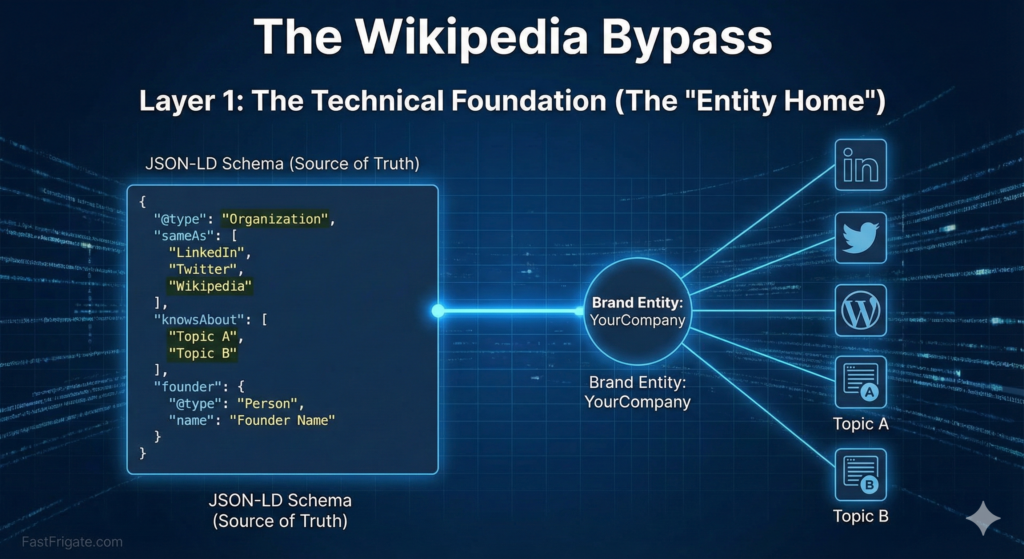
The “Wikipedia Bypass” JSON-LD Template
Don’t just use the standard “LocalBusiness” markup. Use this structure to force the connection between your Brand and your Topic.
Copy this, edit the capitalized text, and put it in the <head> of your homepage.
<script type="application/ld+json">
{
  "@context": "https://schema.org",
  "@type": "Organization",
  "name": "YOUR BRAND NAME",
  "url": "https://www.yourdomain.com",
  "logo": "https://www.yourdomain.com/logo.png",
  "sameAs": [
    "https://www.facebook.com/yourbrand",
    "https://twitter.com/yourbrand",
    "https://www.linkedin.com/company/yourbrand",
    "https://en.wikipedia.org/wiki/Your_Brand_(if_exists)"
  ],
  "knowsAbout": [
    "Sustainable Coffee Farming",
    "Fair Trade Supply Chains",
    "Organic Roasting"
  ],
  "founder": {
    "@type": "Person",
    "name": "FOUNDER NAME",
    "sameAs": "https://www.linkedin.com/in/founderprofile"
  }
}
</script>
Why this works:
sameAs: This reconciles your entity. It tells Google, “That LinkedIn profile? That YouTube channel? That’s also us.” It consolidates your authority signals.knowsAbout: This is the killer feature. You are explicitly telling the Knowledge Graph, “We are an entity that relates to these specific topics.”
Layer 2: The Vector Reputation Layer (Training the AI)
Now that the machine knows who you are, you have to train it to like you.
This isn’t about “getting backlinks.” It’s about Vector Space. LLMs understand concepts by how close words appear to each other. If “Your Brand” and “Scam” appear together often, they have a close vector relationship. You want “Your Brand” and “Trusted Solution” to be the close relationship.
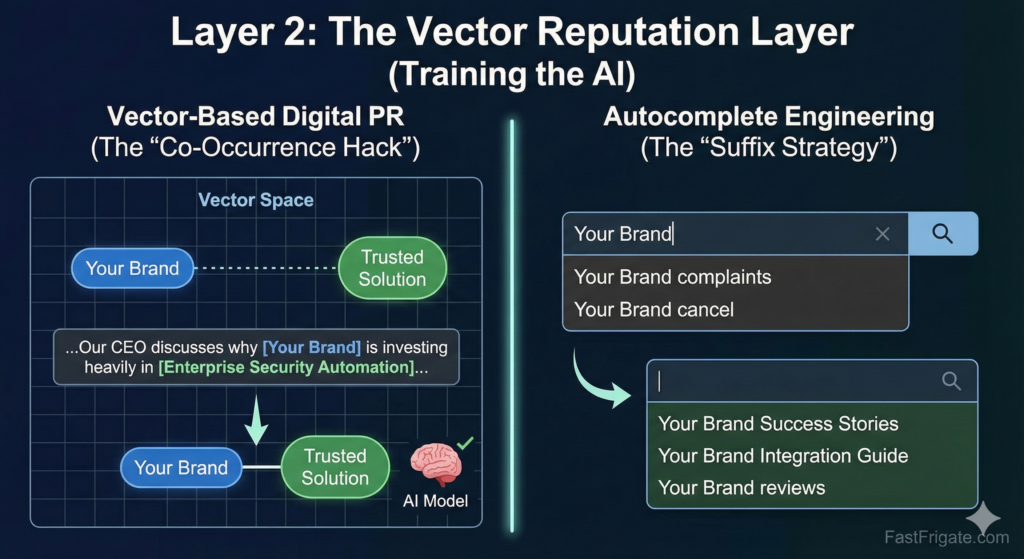
Here are two ways to engineer this.
1. Vector-Based Digital PR (The “Co-Occurrence Hack”)
Stop obsessing over “dofollow” links. For Brand SEO, a mention is a link.
When you pitch a quote to a journalist or a niche blog, your goal is Semantic Proximity. You want your brand name to physically appear in the same sentence as your target keyword.
- Bad Pitch: “Here is a quote from our CEO about industry trends.”
- Good Pitch: “Our CEO discusses why [Your Brand] is investing heavily in [Enterprise Security Automation] this year.”
You want the robot to read those two bolded phrases together. Over time, this trains the model that these two concepts are synonyms.
2. Autocomplete Engineering (The “Suffix Strategy”)
Google’s Autocomplete is the first thing a user sees. If they type your name and see “complaints” or “cancel,” you’ve lost before you started.
You can’t fake this (don’t buy bot traffic), but you can nudge it.
Run a micro-campaign via email or social media that encourages your actual users to search for a specific, positive long-tail phrase.
- Don’t say: “Google us!”
- Say: “Search for ‘[Brand Name] Success Stories’ to see how we helped Company X.”
- Say: “Google ‘[Brand Name] Integration Guide’ to find the documentation.”
Layer 3: The Verification Layer (Measuring GSOV)
If enough real humans search for the suffix “Success Stories” or “Integration Guide,” Google’s prediction layer picks it up. You push the negative suggestions off the board. Like an authoritative badass.
Rank tracking software is dying. Knowing you rank #3 for a keyword doesn’t tell you if ChatGPT is recommending you.
You need to measure Generative Share of Voice (GSOV).
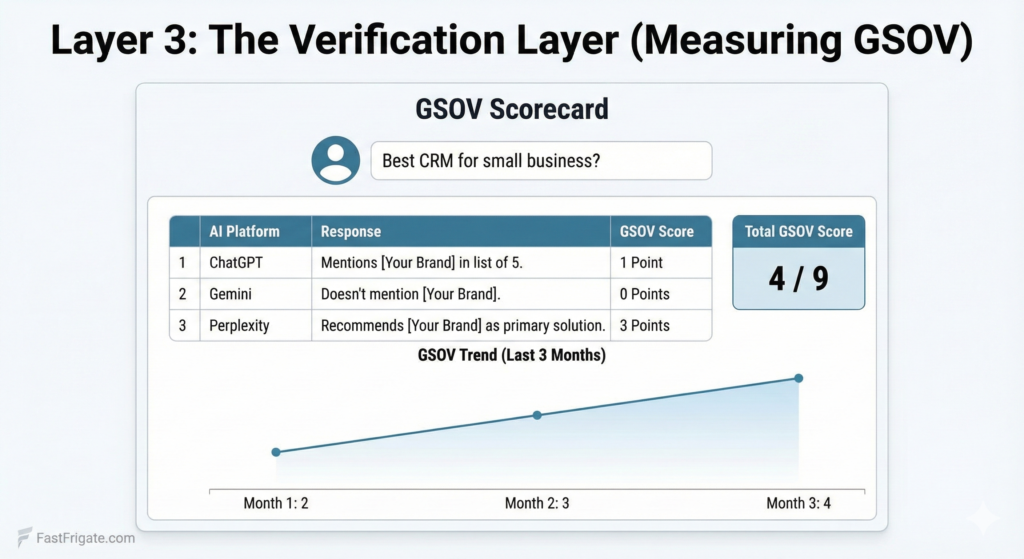
There is no tool for this yet (they’re all lying if they say they do it perfectly). You have to do it manually. Create a “GSOV Scorecard.”
The GSOV Scorecard Protocol
- Pick your top 5 “Money Questions” (e.g., “Best CRM for small business”).
- Open ChatGPT, Gemini, and Perplexity.
- Ask each question 3 times (clear chat in between).
- Score it:
- 0 Points: Not mentioned.
- 1 Point: Mentioned in a list.
- 3 Points: Recommended as the primary solution.
If your score is trending up month-over-month, your Brand SEO is working. If your score is zero, you have an entity problem, not a keyword problem.
The Execution Playbook (Strategies in Action)
Theory is great, but execution pays the bills. Here is how you apply the “Stack” in the real world.
Strategy 1: The “Reddit Defense” (SaaS Company)
The Problem: You run a project management tool. You have great technical SEO, but your GSOV score is low because Reddit threads call you “buggy.”
The Fix:
- Layer 2 (Vectors): You don’t just reply to threads. You flood the zone with new context. You publish a “Stability Roadmap” and have your engineers do an AMA specifically about “Bug Fixes and Performance.”
- Layer 2 (Autocomplete): You email your user base: “Search for ‘[Brand] Uptime Status’ to see our new 99.9% guarantee.”
The Result: The “buggy” vector weakens. The “uptime” vector strengthens. The AI re-evaluates the sentiment.
Strategy 2: The “CEO as an Entity” (Local Service)
The Problem: You own a landscaping firm in Austin. There are fifty other landscapers. You can’t out-spend them.
The Fix:
- Layer 1 (Schema): You use the JSON-LD template to link the Founder (Person) to the Company (Organization).
- Layer 2 (Co-Occurrence): The founder goes on local podcasts. The goal isn’t just links; it’s to have the host say “Austin’s landscaping expert, [Founder Name]” repeatedly.
The Result: When someone asks an AI “Who is the best landscaping expert in Austin?”, the system connects the founder’s proven expertise directly to the company brand. You win because you have a “face” the AI trusts.
Strategy 3: The “Data Pivot” (E-commerce)
The Problem: You sell organic coffee. You want to rank for “sustainable coffee,” but the SERP is dominated by giants like Starbucks.
The Fix:
- Layer 2 (Vector PR): Stop writing blog posts. Conduct a study on “Fair Trade Pricing Gaps.” Pitch the data to major news outlets.
- Layer 1 (Schema): Update your
knowsAboutschema to include “Coffee Economics” and “Fair Trade Data.”
The Result: You get citations from high-authority domains (NYT, Guardian) that link your brand to “Data” and “Fair Trade.” You aren’t just a store anymore; you’re a source.
Frequently Asked Questions
How do I fix AI hallucinations where ChatGPT makes up fake pricing or features for my brand?
You cannot “edit” the AI, but you can dilute the error. AI hallucinations usually stem from a “data void”—the model doesn’t have enough confidence in the real data, so it guesses. The fix is Layer 2 (Vector Reputation). You need to publish the correct data on high-authority 3rd party sites (e.g., press releases, review sites, partner directories) to corroborate your own website’s claims. When the model sees the correct data cited across multiple trusted nodes, it overwrites the hallucination.
What happens if my JSON-LD Schema conflicts with existing sources like Wikipedia or Crunchbase?
This is a “Confidence Score” battle. If Wikipedia says you were founded in 2010, but your Schema says 2012, Google will likely trust Wikipedia because its domain authority is higher. To fix your Knowledge Graph, you cannot just change your website; you must correct the external sources first. Your website is the “Entity Home,” but it is not the only source of truth. The ecosystem must align.
How long does it take for “Autocomplete Engineering” to actually change the search suggestions?
It depends on your baseline search volume. For a massive brand, displacing a negative suggestion might take 3-6 months of sustained, high-volume positive queries (The “Suffix Strategy”). For a local or niche B2B brand, you can often see changes in 30-60 days because the “query threshold” required to trigger a new suggestion is much lower.
My leadership only cares about “Clicks” and Traffic. How do I justify investing in “Unlinked Mentions”?
Show them the “Zero-Click” trend line. In 2026, over 60% of searches end without a click because the AI answers the question directly. If you only measure clicks, you are measuring a shrinking pie. Position Generative Share of Voice (GSOV) as the new “Market Share.” If you aren’t mentioned in the AI answer, you aren’t losing a click—you are losing the customer entirely.
Can competitors “poison” my Brand Entity with negative vector associations?
Yes. If a competitor runs a campaign associating your brand name with terms like “security breach” or “alternatives,” it can affect how LLMs categorize you. This is why Brand SEO is defensive, not just offensive. You need a higher volume of positive semantic proximity (your brand + “secure,” “trusted,” “leader”) to drown out the negative noise in the vector space.
I added the sameAs Schema, but my Knowledge Panel hasn’t appeared. Why?
Schema is a signal, not a command. Google generates a Knowledge Panel only when it reaches a “Critical Mass of Corroboration.” If you have the Schema but no third-party citations (Layer 2), Google assumes you are trying to fake importance. You need to build the citations to validate the Schema. The code tells Google where to look; the citations tell Google what to believe.
The Wrap-Up
Brand SEO in 2026 isn’t about tricking an algorithm. It’s about proving you’re the real deal. The head honcho. The big cheese.
If you build a brand that people actually like and trust, and you feed that data correctly to the machines, skynet, the search engines will follow. If you try to fake it with technical hacks? Good luck. The AI is smarter than that.
 Interpreting the Last Three Google Core Algorithm Tweaks